Why Branches Divide: The Pattern Behind a Tree’s Crown
Why branches divide shapes a tree’s crown. Learn to read its main axes, branch angles and spacing, and see how those features create a recognisable outline.
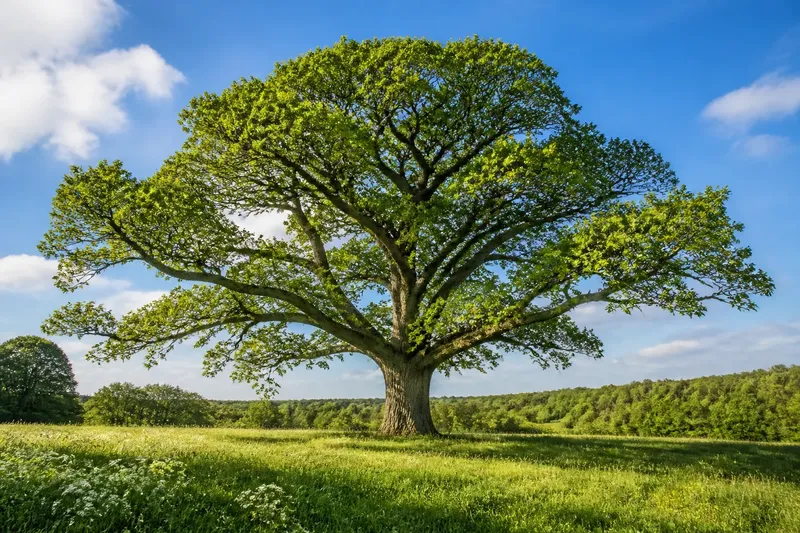
On a walk beneath an old oak, you might notice how its trunk divides into heavy limbs, then smaller branches and fine twigs. Why branches divide helps explain the oak’s crown: the branching framework spreads foliage through the air and connects leafy shoots to the trunk.
Follow that framework and the tree’s outline becomes easier to read. A broad crown, a narrow column or a loose, layered silhouette can reflect differences in how the main axes grow and where branches arise.
Crown branching patterns
A tree crown is the part above the trunk that carries branches, twigs, leaves, flowers or cones. Its framework consists of larger axes, including the trunk and principal limbs, which branch into smaller shoots and eventually end in buds or foliage.
Each division helps shape how the crown occupies space. A branch extending outwards broadens the tree’s reach; an upward-growing shoot contributes to height; fine twigs may fill smaller gaps. The balance varies with the species, the tree’s age and its growing conditions.
In some trees, a leading shoot continues to extend while side branches arise along it. In others, the original tip may stop extending or change direction, and one or more side shoots may grow upwards. These patterns are not fixed templates: they can vary between species, between individual trees and even within a single crown.
A tree’s crown does not always grow around one uninterrupted central leader. A strong main axis can contribute to a tall, tapered outline, while several substantial upward limbs can create a broader or more rounded one. The direction and relative size of the limbs also matter.
Branch direction and light
Branches do not emerge as a flat set of spokes. Their positions and angles reflect the arrangement of buds and shoots, the tree’s growth pattern and its surroundings. Light and gravity influence shoot growth, but their effects differ between species and are shaped by conditions around each branch.
A branch reaching towards an opening may have more room to extend, while a shoot shaded by neighbouring foliage may become less prominent. Over time, new growth, shade and the loss or slowing of older branches all contribute to the crown’s changing pattern.
Branch angle affects the tree’s outline. Steeper limbs often contribute to an upward shape; more horizontal limbs spread the crown; drooping branches can give it a soft or pendulous look. These are visual tendencies, not rules that apply to every branch or tree.
The same tree may carry branches at several angles, and its form changes as it grows. A crown is the result of repeated growth over time, rather than a single, fixed design.
Branch size and hierarchy
The relative size of the trunk and limbs helps you read the crown’s structure. A prominent trunk that divides into progressively smaller branches creates a visible hierarchy, which the eye can follow from the base towards the finer tips.
When several upper limbs grow to similar prominence, the crown may divide into distinct leaders. This can produce a forked, open or multi-stemmed appearance. It is not automatically a defect: some trees naturally develop several main axes, so it helps to consider the species and the tree’s overall condition.
Smaller branches add texture. Closely arranged fine twigs can make a crown look dense, while longer, more widely spaced shoots leave visible gaps. A tree may appear full from a distance even when its largest limbs are widely separated.
Imagine a young ornamental tree with one upright leader and side branches growing out at different angles. If the leader continues to extend while the side branches remain less prominent, the tree may develop a tapered outline with a visible central axis. That is a possible pattern, not a prediction: later growth and the tree’s conditions may change the balance.
Why crowns take different shapes?
Why does a tree have one main leader?
One upward-growing shoot may remain more prominent than its neighbours, creating a clear central line. The resulting crown may look narrow or tapered, depending on the side branches and how the tree grows.
Why does a crown split into several leaders?
Several upward shoots may develop with similar prominence, leaving no single leader clearly dominant. The resulting crown can look broad or irregular, and this form may be natural for that tree.
Why do lower branches become less prominent?
As a crown grows, foliage above can shade lower branches. Some trees gradually shed branches that receive less light, while others retain them; the pattern depends on the tree and its circumstances.
Why do some branches grow almost horizontally?
Branch angles reflect the shoot’s position, growth pattern and surroundings. Horizontal limbs spread the crown sideways, while more upright ones contribute to its height, with many trees combining both.
Reading a tree crown
Start at the trunk and follow the largest limbs. Look for a continuing main leader or several limbs sharing the upward direction, then trace how each divides into medium-sized branches and finer twigs.
Step back to see the whole silhouette, then look more closely at one limb. The distant view reveals the crown’s overall balance; the closer view shows branch direction, spacing and the density of the twigs. A bare deciduous tree can make the framework easier to trace, while leaves show where foliage gathers.
For a useful comparison, choose two trees in similar surroundings. Notice whether one has a clear central axis and the other divides into several substantial limbs. Compare the relative size of their branches, their angles and the gaps between them, rather than judging which tree looks tidier.
It is not worth trying to name every branch type at a glance. To read a crown, it is usually more useful to notice where the main axis continues, where it divides and how smaller branches fill the available space.
- Check whether one shoot continues above the others; if so, note a possible leading axis, but allow for changes in later growth.
- Check whether several upper limbs are similarly prominent; if so, read the crown as multi-leader rather than assuming it has a single central line.
- Check whether the largest limbs divide into progressively smaller branches; if they do, follow that hierarchy, but if they do not, note the larger forks instead.
- Check whether branches point upwards, sideways or downwards; if one direction dominates, use it to describe the silhouette, but note mixed angles when they occur.
- Check whether twigs are closely spaced or leave clear gaps; if closely spaced, describe the crown as visually dense, but if gaps dominate, describe it as more open.
- Check whether lower branches are shaded by foliage above; if they are, consider shade as one possible influence, but look for other conditions before explaining their appearance.
Conditions and crown change
A tree’s branching pattern develops under changing conditions. Nearby trees may shade one side, while an opening at a woodland edge can give a shoot more room. Wind exposure, age and species also influence how branches are arranged.
Two trees of the same kind may therefore have different outlines. One may have had more room on one side; another may have grown among neighbouring crowns. Their shared form can still be recognisable in the way the trunk and larger limbs divide.
Pruning can alter a crown’s appearance by removing or shortening branches, but it does not replace the tree’s underlying growth pattern. If you are considering work on a substantial tree, ask a qualified arborist for advice suited to the tree and the work involved.
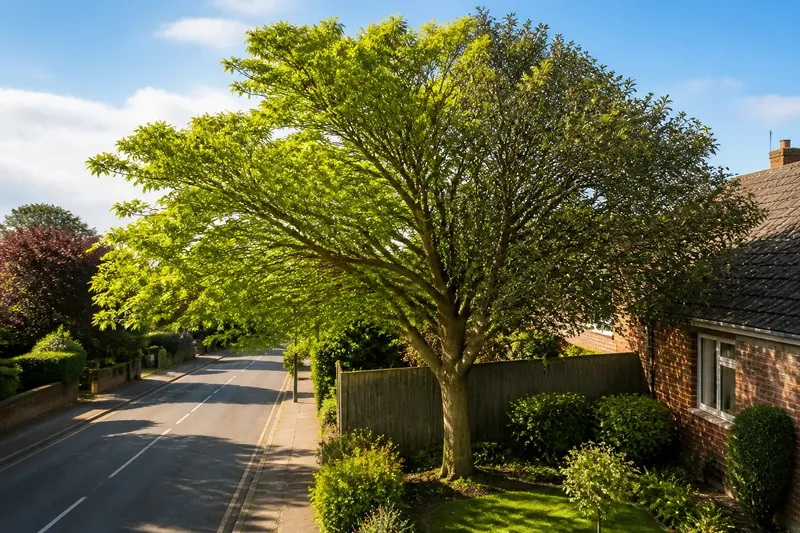
Understanding why branches divide makes a crown easier to read as a framework rather than a green cloud. Next time you pass a street tree, trace its largest limbs with your eyes and follow one towards its finer twigs. The main phrase, why branches divide, points to a useful habit: look for the pattern first, then notice how the tree’s surroundings have shaped it.