Before the Botanical Garden: How Trees Entered Written Catalogues
Written tree catalogues paired names with descriptions and places, helping readers compare records and notice where an old label may be uncertain.
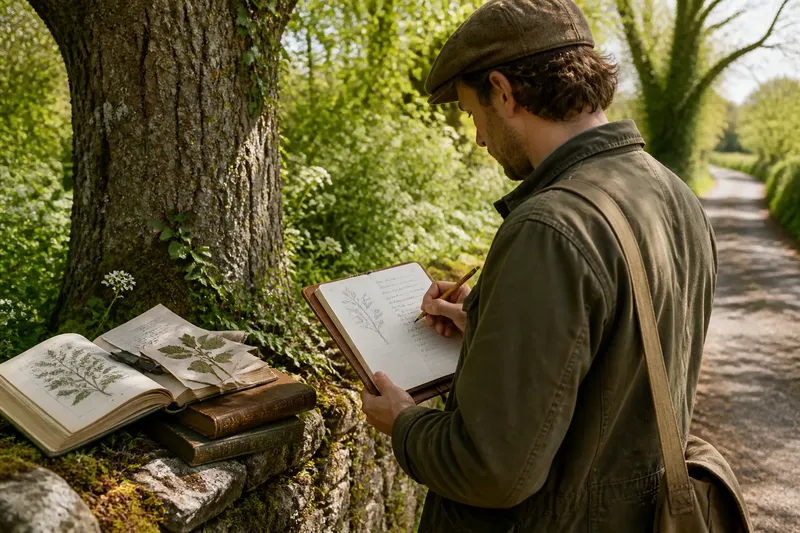
A gardener pauses beside a lane-side tree, asks a neighbour its name and writes the answer next to a quick sketch. The note is modest, but it raises a question familiar to anyone reading old tree catalogues: what did a name mean, and where had the tree been seen?
Names in context
Before botanical gardens became established centres for plant study, people recorded plants for practical, scholarly and personal reasons. The surviving record is varied rather than one continuous catalogue tradition: names and descriptions appeared in works such as herbals, garden lists and accounts of useful plants, each shaped by its compiler’s purpose.
A name could differ from one locality to another, while the same name might refer to different trees. Gardeners, landholders, herbalists and plant gatherers supplied names rooted in everyday use. A tree might be known for its fruit, timber, shade or place in a familiar landscape.
Writing a name down preserved a clue, not a settled identity. A useful entry set the name beside a description, a place, a season or the person who supplied it, giving later readers something to compare.
Descriptions that distinguish
A recorder might note a tree’s general form, leaves, flowers, fruit, bark or growing setting. The aim was not to capture every detail, but to make the subject recognisable beside other trees with similar names.
Description also reflected the recorder’s interests. Someone concerned with timber might attend to trunk form; a gardener might note flowering or fruit. A catalogue therefore reveals what its compiler considered worth recording, not simply what grew nearby.
Drawings and specimens could add evidence. A sketch might clarify a leaf or branching pattern, while a pressed specimen preserved physical material. Each had limits: a drawing might omit colour or scale, and a specimen could lose the context of where it grew.
Places and records
A location could turn a description into a record of where a tree had been observed. An entry might name a garden, estate, roadside, woodland or region. Even a broad place name could help distinguish a cultivated tree from one reported growing without deliberate planting.
Place notes let readers compare accounts, but they did not explain every difference. A detailed garden record might identify a particular plot; a distant report might give only a district. The record could reflect the compiler’s contacts as much as the full range of trees in a landscape.
Catalogues were arranged for different purposes. Alphabetical order made a known name easier to find, while arrangements by use, locality or visible features supported other kinds of comparison. Every system helped with some questions and made others harder to ask.
Comparing tree catalogues
Written records could be copied, shared or consulted alongside other accounts. The surviving evidence does not justify treating every catalogue as part of a single, uniform system of exchange. Still, when two records used different names for similar trees—or the same name for distinct ones—readers had reason to look more closely at descriptions and sources.
That comparison is useful today, too. An old label should be read with its accompanying details rather than silently replaced by a modern name. Keeping the original wording visible makes uncertainty easier to recognise.
Keeping notes useful
A record can be updated when a name, place or description becomes clearer. Keeping earlier wording alongside a correction helps a later reader see what changed and why, instead of making uncertainty disappear.
Say you find an old garden notebook listing a “white-fruited thorn” beside a note about a hedge near a village. You visit the hedge and record the date, the tree’s visible leaves and fruit, the precise location, and the notebook as your source. You cannot establish the tree’s identity from the old name alone, so you retain that name as a historical label and leave the identification open; a later reader can compare the observations without mistaking your guess for a fact.
For a small tree catalogue, check each entry against these points. Each result should lead to a clear decision, not an unsupported identification:
- Name: Check whether the name came from a person, a book or a label. If its source is clear, record it; if not, mark it as unverified and do not present it as established.
- Description: Check for observable features such as leaves, bark or fruit. If the details distinguish the tree, keep them; if they are too general, add a feature you can actually observe or leave the identification open.
- Place: Check whether the location can be found again from the note. If it is specific enough, retain it; if it is vague, add a landmark or broader area without inventing precision.
- Time: Check when the observation was made, especially if flowers or fruit are mentioned. If the date is known, record it; if it is missing, mark the season or timing as unknown rather than inferring it.
- Source: Check who supplied the name or where the older record came from. If the source is traceable, cite it in the entry; if it is not, label the information as unattributed.
- Uncertainty: Check which part of the entry remains unclear. If the tree cannot be identified confidently, preserve the recorded name and describe the uncertainty; if new evidence resolves it, add the basis for the revision rather than deleting the earlier note.
Ornate prose is not worth the effort if it hides the basics. A short, legible note with a useful place, observable details and an honest account of uncertainty is easier to compare later.
Why do tree catalogues matter?
Were catalogues only lists of names?
No. Some records paired names with descriptions, places, drawings or specimens. Those details help readers judge what a name might refer to and compare accounts without assuming that matching words mean matching trees.
Who recorded trees before botanical gardens?
People with gardening, landholding, collecting, practical or scholarly interests recorded plants in different kinds of writing. Their aims varied, so one account might focus on useful wood while another attended to cultivated or local plants.
How did written records organise tree knowledge?
They gathered observations into forms that readers could consult and compare. Naming and arrangement made records easier to use, while disagreements between accounts pointed to questions about identity, description or place.
Can an old tree name identify a tree today?
It can offer a clue, but a name may be ambiguous or may have changed meaning. Read it beside the recorded place and description, and leave the identification open if those details do not settle it.
Gaps in the record
A catalogue’s omissions deserve care. A tree absent from a list may have been overlooked, considered unimportant, hard to reach or known by a name the compiler did not recognise. Its absence from the page does not prove that it was absent from the landscape.
Written tree catalogues remain useful as records of what particular people chose to notice and how they organised it. When you encounter an old tree name, start with the surrounding description, place and source; those details can support a better new entry than the name alone.