The Neat Crown Myth: Why Trees Do Not Grow to Match
Tree crown shape reflects light, space and growing conditions. Learn why uneven branches are normal responses, and when a sudden change deserves attention.
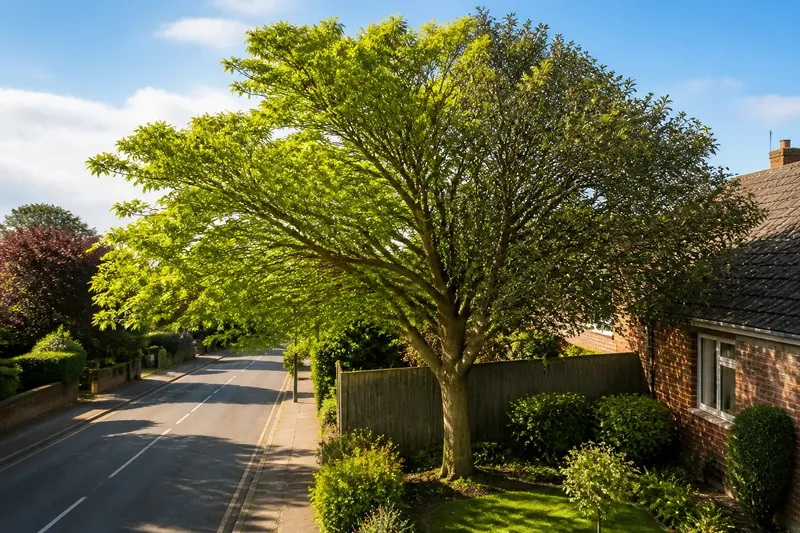
On a walk past a front garden, you might see one side of a tree reaching over the street while the other stops short. That uneven tree crown shape is not a failed attempt at symmetry: branches grow in response to the particular light, room and exposure around them, so two sides of the same tree may develop differently.
A tree does not have a target outline to match on either side of its trunk. Its crown—the arrangement of branches and foliage—takes shape as individual shoots grow in different conditions over time. Before reaching for pruning tools, look at what the tree is growing around.
Light shapes crowns
What you see: The crown is fuller on the sunny side, with branches extending towards an open gap. That gap might be above a road, lawn or neighbouring hedge.
Why it happens: Shoots with access to light may extend more readily than shoots shaded by a wall, another tree or the crown itself. The tree’s growth records those uneven conditions; it does not actively try to centre its outline around the trunk.
What to do: Observe where direct light reaches the tree at different times of day. Note nearby structures and trees that cast shade, and compare the outline over time. If the tree appears healthy and its branches create no hazard, leaving its shape alone may be the sensible choice. Cutting the fuller side merely to even the silhouette removes healthy foliage without changing the shade behind it.
Space limits branches
What you see: Branches stop short on one side, turn away from a roof or wall, or spread into open space while the other side stays compact. A tree planted close to a building can look clipped without anyone having pruned it.
Why it happens: A building, fence, neighbouring crown or narrow planting strip can restrict where branches extend. The outline may reflect years of growth around that obstacle rather than a recent change.
What to do: Identify which parts of the crown have room and which meet a fixed boundary. If you are choosing a tree for a new planting spot, ask a knowledgeable nursery or arborist whether its mature form suits the available space. For an established tree, do not remove large limbs just because they approach a structure; seek an arborist’s advice where clearance or property concerns matter. Work near buildings or public spaces should also be discussed with the relevant owner or local authority.
Pruning leaves gaps
What you see: One side has a blunt edge, upright shoots or a hollow-looking patch where branches are missing. The remaining limbs may extend unevenly around an old cut.
Why it happens: Previous pruning may have cleared a path or let more light through a window. Later growth does not necessarily fill the gap neatly: shoots may emerge near cut points and develop differently according to their position and access to light.
What to do: Use any known history of pruning to understand the outline, then inspect the tree from several angles. Distinguish an old, settled gap from recent changes such as dead twigs or a broken limb. Cutting healthy growth elsewhere to disguise a gap is unlikely to make the crown truly balanced. Ask a qualified arborist about substantial limbs or uncertain branch condition rather than attempting risky work yourself.
Wind affects growth
What you see: The crown appears swept in one direction, or branches are shorter and more compact on the side facing frequent winds. This can stand out in an exposed garden or open street.
Why it happens: Repeated exposure can affect how shoots extend and branches develop. A tree in an open spot may take a different form from the same kind of tree sheltered by buildings, hedges or other trees.
What to do: Consider the setting before comparing the tree with a sheltered specimen elsewhere. Notice whether the outline is longstanding or has changed after a storm. If a branch is newly cracked, hanging or obstructing a route, keep clear and contact the property owner or an appropriate tree professional. Do not try to make a long-established wind-shaped crown symmetrical by cutting it back.
When is a crown change concerning?
Does an uneven crown mean a tree is unhealthy?
Not by itself. Light, obstacles and exposure can all produce an uneven outline, so judge the crown by its condition and changes rather than symmetry alone.
Should I prune the fuller side?
Not simply to make the crown look balanced. Removing healthy branches can reduce foliage while leaving the conditions that shaped the outline unchanged.
How can I spot a recent change?
Compare the tree from the same viewing point over time, watching for new bare patches, broken branches or a sudden shift in its outline. A settled shape differs from a fresh change that merits closer attention.
When should I contact an arborist?
Seek qualified advice if large branches are damaged, the crown has changed suddenly, or proposed work involves a building, public route or substantial limbs. Follow relevant local requirements before arranging tree work.
A crown in context
Say you have a young tree leaning towards an open driveway, with a tall fence shading the other side. You note where light falls at different times, check that the branches have room, and see no sign of recent damage. The likely decision is to leave the tree as it is and keep an eye on its shape, rather than cut healthy branches for a neater outline; if you notice a sudden change later, ask an arborist to assess it.
It is not worth trimming every small irregularity or repeatedly comparing a garden tree with a rounded nursery specimen. That comparison ignores the different places and conditions in which the two crowns have grown.
When you next assess a tree crown shape, begin with the light, nearby obstacles and any recent changes. A tree that does not grow to match is often responding to the space it has; a sudden alteration, rather than an imperfect outline, is the reason to look more closely.