A Winter Walk for Reading Deciduous Trees
A winter walk for reading deciduous trees reveals buds, fallen leaves and fruit; learn what to notice and how to record clues for later identification.
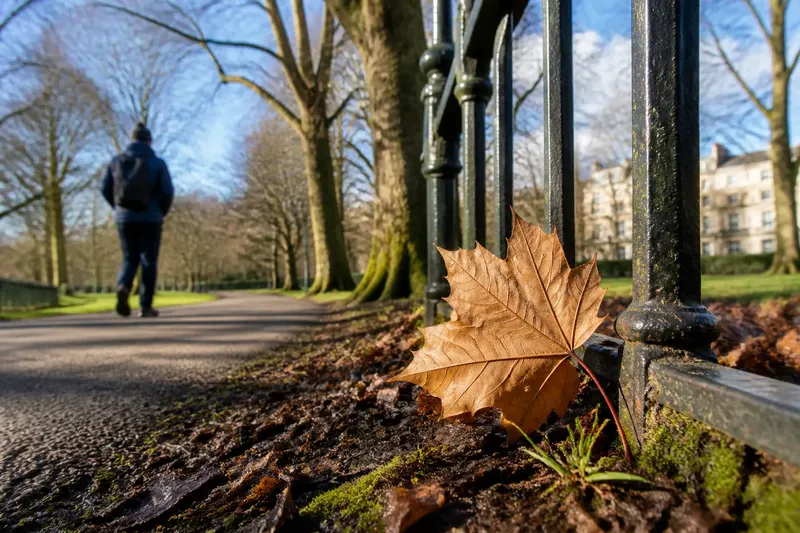
A copper beech leaf caught in a park railing can tell you more than a bare crown glimpsed between buildings. On a winter walk for reading deciduous trees, look down as well as up: fallen leaves, seed cases and fruit often remain after the canopy has emptied.
Winter is a season for collecting clues, not forcing a name. A small notebook and a repeatable route help you link what lies on the ground to the tree overhead, while keeping uncertainty visible.
Start with the ground
Choose a path where you can pause without blocking other walkers, and check the ground beneath several trees. Look for leaves, winged seeds, cones, husks or persistent fruit. These may have blown from another tree, so treat their location as a lead rather than proof.
Notice the leaf’s outline, edge and arrangement of veins. A simple description such as “lobed leaf, pointed tips, strong veins from the centre” is easier to compare with a field guide than “oak-like”. If the leaf is wet, torn or partly buried, say so in your note; damage can hide useful details.
Seed structures offer another route. Ash keys are narrow and winged, while many maples produce paired winged seeds; both can travel away from the crown. Check several nearby specimens and the direction of the wind-exposed path before connecting a fallen object to a particular trunk.
Check buds and twigs
When a low twig is visible from the path, use binoculars or a phone camera’s zoom rather than pulling it down. Note whether buds sit opposite one another or alternate along the twig, and whether they look rounded, pointed, clustered or covered in scales. These patterns can be more useful than a distant outline, though they rarely settle an identification alone.
Look for the small scars left where leaves were attached, along with any persistent seed clusters. Avoid snapping a twig to inspect it. If the buds are too far away to see clearly, record that limit and return when the tree is easier to observe.
Make a clue record
Use one short entry for each tree, with the same headings each time. The following checks make the next decision explicit:
- Ground finds: Check for leaves, seeds or fruit beneath the crown. If several matching items sit directly below it, compare them with the trunk and buds; if they are scattered or mixed, treat them as unassigned clues.
- Leaf details: Check the outline, edge and veins of any intact leaf. If those features are clear, record them for a guide comparison; if the leaf is torn or decayed, note the damage and do not rely on its shape.
- Bud position: Check whether visible buds are opposite or alternate. If the pattern is clear on several points, add it to the identification notes; if distance obscures the twig, leave the pattern undecided.
- Seed shape: Check for wings, paired forms, husks or clusters. If the shape is distinctive, compare it with a guide; if it may have blown in from elsewhere, keep it separate from the tree’s confirmed clues.
- Tree location: Check what stands directly above the find and whether other trees overlap. If one crown is clearly associated with the material, note that connection as likely; if several crowns meet, record the source as uncertain.
- Photograph: Check that an image includes enough context to identify the tree or its location. If it does, pair it with the written note; if it is only a close-up, add a wider image or a place description before moving on.
- Next visit: Check which feature was unavailable in winter, such as flowers or fresh leaves. If that clue could distinguish your leading possibilities, plan to revisit when it appears; if not, keep the identification open rather than collecting redundant images.
Compare without guessing
Imagine you find a broad, lobed leaf beneath a tree on a park path, along with several matching leaves caught in the grass. You note the pointed lobes, the nearby trunk and the fact that other crowns overlap; then you photograph the leaf beside the trunk and mark the tree as a possible match, not a confirmed one. A field guide suggests checking buds, so you look from the path with binoculars, find that the buds are too distant to read, and leave the name open until a clearer seasonal clue is available.
This method keeps the record useful even if the first guess changes. Write observations first and any proposed name separately. An identification app or field guide can suggest candidates, but compare its diagnostic features with what you actually recorded.
What should you look for?
Can fallen leaves identify a tree?
They can narrow the possibilities when the leaf is intact and clearly linked to a nearby tree. Wind, foot traffic and mixed plantings can confuse that link, so compare leaves with other clues before settling on a name.
Are buds useful in winter?
Yes, bud shape and arrangement can help distinguish trees when they are visible. Use binoculars or a zoomed photograph from a safe place, and leave the detail unrecorded if it is too distant to judge.
Should I collect seeds or leaves?
Usually, a photograph and a written description are enough for a casual walk. Follow local park rules, avoid damaging living plants, and do not collect material where it is prohibited.
When should I return?
Return when buds open or fresh leaves appear, especially if those features could separate your leading candidates. Use the same viewpoint and compare the new evidence with your winter notes.
Skip needless collecting
It is not worth filling a bag with every leaf or trying to reach a high branch. A few well-described clues, linked to a place and a photograph, are easier to revisit than a pile of unlabelled material.
For a winter walk for reading deciduous trees, the useful result is a short record of what you saw, what remains uncertain and what seasonal clue could answer the next question. Keep the note modest, and the tree can supply the next piece when the season changes.